Solar PV & battery storage
Solar is now firmly cost-positive for most Wirral homes — payback is typically 6–9 years on a 4kW system, faster if you add a battery and shift consumption to off-peak. We work with the MCS-certified installer network for the panels themselves and handle the full electrical integration: inverter, battery, EV charger interlock and SEG export registration.
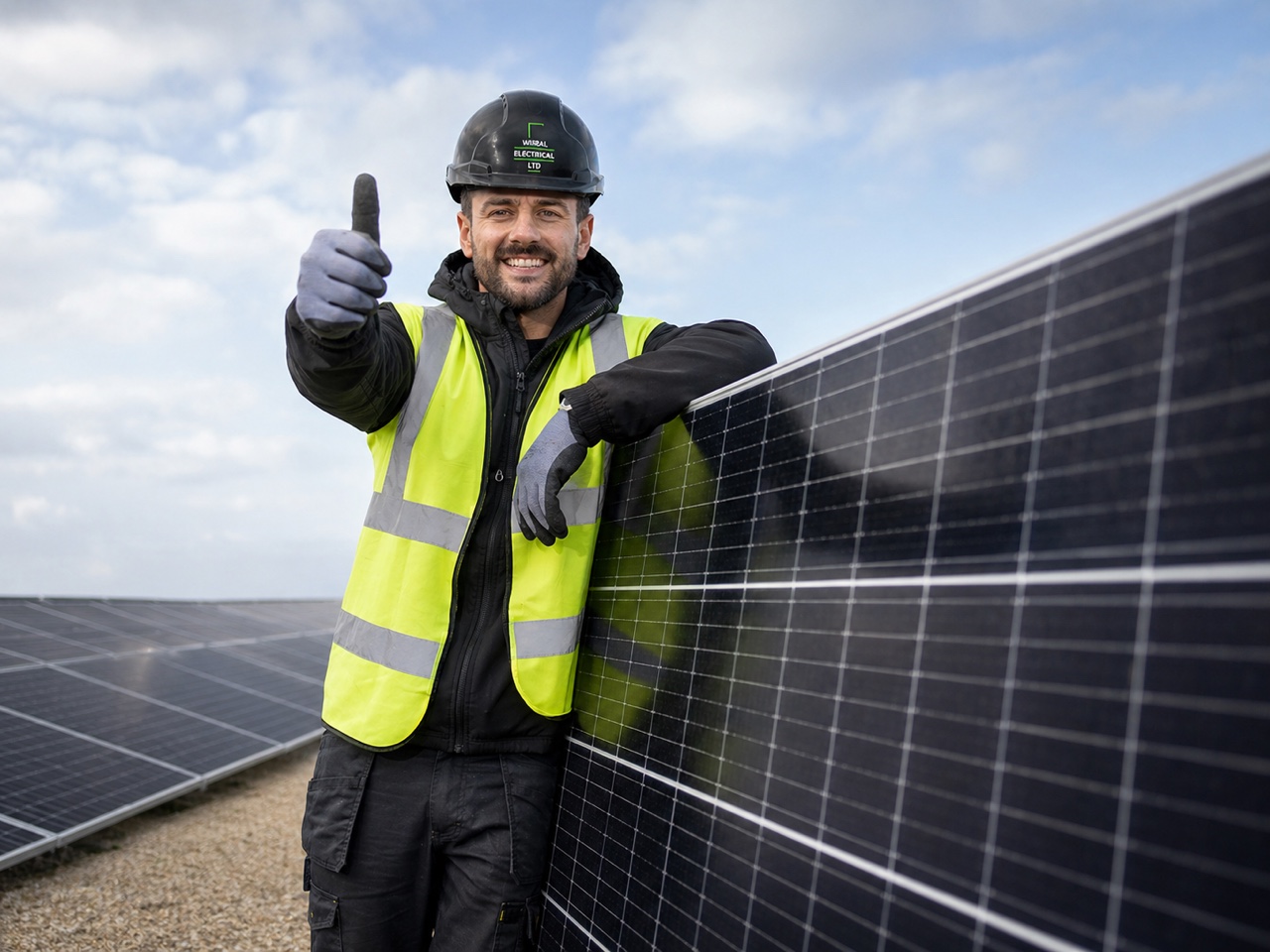
- In-roof or on-roof solar panels (4–8kW systems most common)
- Hybrid inverter (single or 3-phase)
- Battery storage (5kWh–15kWh ranges)
- Smart switching for EV charging from solar surplus
- Generation meter and SEG export registration
- MCS certificate + Building Control notification
Homeowners with south-, east- or west-facing roof space (north-facing rarely worth it), people who already have an EV or heat pump (consumption shifts the maths heavily in your favour), and anyone wanting to insulate against energy price rises.
A typical Wirral 4kW system generates around 3,400–3,800 kWh per year — about 80–90% of the average household's annual electricity. With a battery sized to your evening demand you can self-consume 70–80% of what you generate; without one, more like 35%.
We integrate solar with EV charging via a MyEnergi Zappi or similar — your car charges from surplus solar in summer and from the grid (or battery) in winter. The maths gets very favourable if you commute over 40 miles a day.
Frequently asked
Will solar work on my roof?
South-facing is best, east- and west-facing both viable (about 80% of south-facing yield), north-facing rarely. Pitched roofs between 25° and 50° work well. Flat roofs need ballasted frames. Send us photos of your roof and we will give you a yield estimate before any survey visit.
How long do panels last?
Panels are typically warranted at 80% output for 25 years and most last 30+. Batteries have a 10-year warranty (or about 6,000 cycles, whichever comes first). Inverters tend to be the weak link — plan for one replacement at year 12–15 in your lifetime cost.
Do I need planning permission?
Almost never on a normal house — solar is permitted development. Listed buildings and conservation areas are the exceptions. We check before quoting.
What happens during a power cut?
A grid-tied system without a battery shuts down during a power cut for safety reasons (anti-islanding). With a battery and a hybrid inverter you can keep critical circuits running off the battery for 8–24 hours depending on size. Worth specifying if you work from home.
Can I claim VAT relief?
Yes — the 0% VAT rate on solar PV, battery storage and heat pumps in residential use runs until at least March 2027. Commercial installs go at 20% VAT.